Showing posts with label jiu-jitsu. Show all posts

Monday, July 14, 2014

That Really Cool Move I Learned Last Week But Can't Remember Now

"He has forgotten more techniques than most of us will ever know in our lifetime!" I have heard this said about some of the masters of BJJ before. What a great compliment to pay somebody; I hope people could say this about me someday. Of course, what this saying implies is that the practitioner knows a great deal about BJJ.

As a 'young' blue belt (experience, not age-wise), you could say this statement about me in reference to some people -- those who come to a few classes and never come back. But as time go on, and I spend more and more hours on the mats, I am no longer the new guy in the gym. People come in who are bigger and stronger than I, and I am able to control them because I have learned technique. So now occasionally (only occasionally!) you could say that I have forgotten more BJJ techniques than somebody presently knows. As time goes on, and I leave more sweat, blood, and tears on the mat, I hope that this statement will become more and more true.

What originally got me thinking about this subject is the fact that I have gone to many seminars, many of them two to four hours in length, and I remember very little of what I was taught in the seminars. Of course, one reason is that I have not drilled the techniques enough. I give up on some techniques too easily. But I think the main reason is the sheer abundance of the material. Usually when I go to a seminar, I learn many techniques, but there will be one or two things that really change my game, and I am okay with that.

There are so many techniques that I will never learn them all, but I can think of one simple thing to improve in this area: taking notes. Whether it is a four hour seminar or 30 minutes of instruction in class, it is very easy to jot a few things down to jog my memory. Of course it would be better to be described as a walking encyclopedia of jiu jitsu techniques, but that comes slowly. I think that writing techniques down would be one of the means to that end. I have been told by instructors before that I should be writing things down, but I have just never done it. I also have friends who tell me that they should be journaling their BJJ techniques, but I don't see anybody doing it consistently.

So when you see me scribbling during class, that is what I am doing. I will check back in and present my findings, whether I notice a change right away, or whether it is something that takes place over months or years

Wednesday, July 2, 2014

Grappling Takedown Development and Dental Treatment


Photo Credit: Dave Freetage

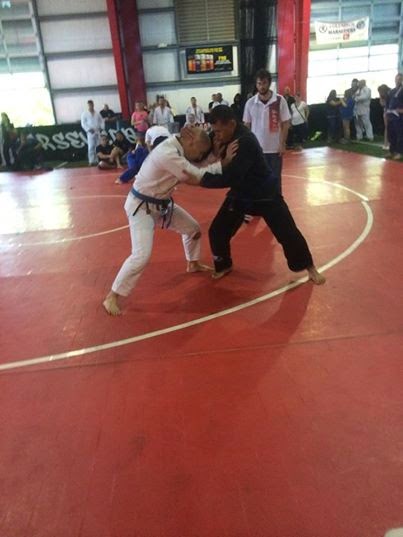
As as grappler, takedowns are a very important skill. Another important related skill is takedown defense. Takedowns are critical because this is often the point at which one individual begins to dominate the fight. When I take someone down, this often becomes the pivotal point at which I begin to control my opponent. I have been focusing on my takedown technique for several months now, but this is still a set of skills where I am in deep need of further development. A successful takedown can often expend an extreme amount of energy, especially when one's opponent is skilled at takedown defense. At first glance, takedowns may appear to be simple or easy, but one does not become truly skilled at takedowns until s/he spends hours upon hours practicing thousands of takedowns.

I have found this principle to be true in many aspects of my life. There are professional skill sets that may appear to be easy from a distance, but actually require countless hours to perform successfully, skillfully, and effectively. Such skills are extremely important, require tremendous expenditure of energy, and are worth every bit of effort that is invested into them. One example from my life is the placement of a simple tooth-colored composite restoration (filling) on a child or adult with an intellectual or developmental disability. There are many variables that come into effect during the course of treatment, and many things have to be done well at one time in order to be successful. When all of the elements are performed correctly in synchrony, the result is an effective procedure with a satisfied and relieved patient/parent.